Introducing the Artist Discovery Studio GPT - Part 1: Why Emulate Artists?

Updated: Aug 29
Last Update: 8/29/2026 - added brief backgrounds, works, and links for the highlighted artists. Added a section on Eva Gonzalès.
It has been more than a year since I posted my original introduction to the Synthetic Emulation and Reinvention Images (SERI) project. When the project started, I had two main goals: to explore artists of the past through artificial intelligence and to investigate the creative process in the models I used—specifically, ChatGPT and DALL·E 3.
The SERI process was fairly simple. Start by building a conversation with ChatGPT around an artist - their life, their works, their preferred mediums, their influences, and so on. Then ask ChatGPT to generate a few prompts for Dall-E 3 to turn into "homages". The stroke of brilliance, or so I thought, was to have ChatGPT critique the resulting images and suggest improved prompts, which Dall-E 3 could then use to create further (better?) images. The results were initially exciting, but ultimately disappointing.
After a year, it was clear to me that I had failed to meet both my goals. I had not learned nearly as much about the artists I studied as I could have, and the creative process of artificial intelligence was still mostly a mystery to me. And I only had myself to blame.
I didn't learn as much as I should have about the artists I studied, because I rushed through the process to get to the prompts and images. And I didn't learn much about how artificial intelligence can be creative, because, again, I rushed on to the next artist before pausing to consider any "lessons learned" from the current artist under study.
As a result of these failures, I recently decided to focus on using ChatGPT to learn more about past artists and their work, and less on how the creative process in artificial intelligence works. I designed a GPT to encourage the user to explore artists and their art using interactive exercises and activities such as guiding the user through a close examination of a specific work, playing a visual or historical detective game related to an artist or an artwork, curating a miniature exhibit, recommending other artists or artworks to explore, and so on.
This is the Artist Discovery Studio GPT.
So far, I am having a lot of fun using it and learning more about artists and their artworks. But I have not forgotten the roots of this GPT, and I still use it to create "homage" prompts and images.
The question is - Why?
After all, if I really want to learn about artists, why not get a book? Or go to a library? Or visit a museum (virtually or in person)? These are all excellent points, some of which I have also done, and all of which I should do more. But my curiosity is not limited to artists and art history. If I am being honest with myself, I am still very curious about how artificial intelligence intersects with human art, and how it can be used creatively.
This is where emulation—or, in the language of my earlier project, emulation and reinvention—enters the picture. We tend to regard art as a quintessentially human endeavor. Other animals engage in art-adjacent activities, such as building elaborate structures, decorating nests, and playing creatively, but they do not appear to make or conceptualize art as humans do. Artificial intelligence complicates this distinction: Can it create and discuss art in ways meaningfully comparable to human artistic practice?
We tend to regard art as a quintessentially human endeavor. Can artificial intelligence create and discuss art in ways meaningfully comparable to human artistic practice?
This question keeps nagging at me, and so I keep testing AI art generators with different emulation or homage prompts. At this point, I don't really expect to find any great insights into artificial intelligence or creativity. But I find pleasure in noting the "choices" the AI models make, and the images they produce.
With that said, I will share a few of the emulations produced with the ADS GPT, along with some very brief comments on each image. For each artist below, I am including a representation of one of their actual works, a very brief description of the artist, and one or more emulations. In a couple of cases, due to copyright concerns, I have provided links to a collection of the artist's works rather than post the images here. If the description of the artist is followed by (OpenAI, 2025/6), that means the description was created using ChatGPT.
Here we go.
Gustave Doré

Gustave Doré (1832–1883) was a French artist, illustrator, and engraver best known for his dramatic, highly detailed engravings that brought literary works to life. His illustrations for The Divine Comedy, Paradise Lost, Don Quixote, and The Bible established him as one of the most influential illustrators of the 19th century. His work is characterized by a mastery of light and shadow, grand compositions, and an almost cinematic sense of movement, making his illustrations both haunting and awe-inspiring. (OpenAI, 2025)
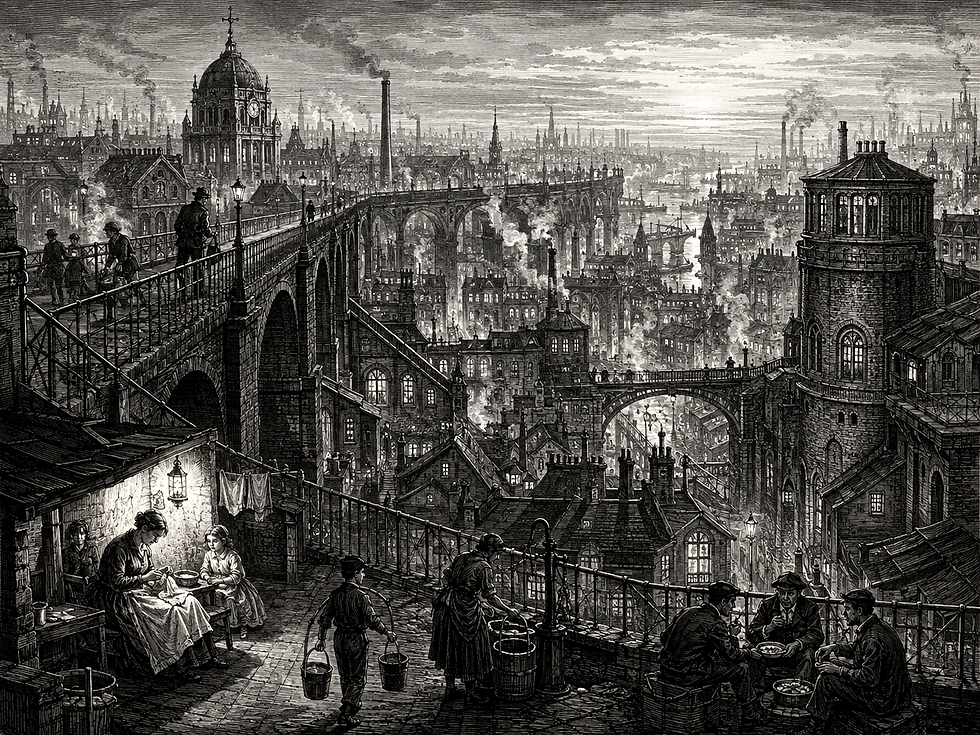
The image above is clearly modeled on Doré’s “Over London - by rail,” from Doré and Blanchard Jerrold’s London: A Pilgrimage. Yet it is not a copy. This version is more cinematic, offering a sweeping view of London’s bridges, railways, waterways, and factories. Doré’s illustration, by contrast, provides a claustrophobic glimpse into a poor neighborhood. Its receding horizon suggests the city’s vastness, but not its grandeur.
Still, the emulation succeeds in several respects. Both images convey the city’s vast scale and depict individuals who are quickly absorbed into the urban landscape as the viewer’s eye moves beyond the foreground. The AI-assisted image also evokes the black-and-white aesthetic of nineteenth-century reproductive print culture—at least from a distance. Importantly, I did not ask the ADS GPT to emulate “Over London - by rail” specifically, but to create “an homage prompt to Doré’s London engravings.” Judged against that broader aim, the image succeeds fairly well.
Camille Pissarro

Camille Pissarro (1830–1903) was a Danish-French painter and a key figure in the Impressionist and Post-Impressionist movements. Known for his vibrant landscapes and city scenes, he emphasized light, color, and everyday life with loose, expressive brushwork. Works like The Boulevard Montmartre at Night and The Harvest showcase his dedication to capturing atmosphere and movement. As a mentor to artists like Cézanne and Gauguin, Pissarro played a crucial role in shaping modern art. His later work incorporated elements of Neo-Impressionism, making him a bridge between artistic movements and a foundational figure in 19th-century painting. (OpenAI, 2025)

As a central figure in Impressionism who also experimented with Neo-Impressionism—and whose work is widely reproduced online—Camille Pissarro should be a relatively accessible artist for the ADS GPT to emulate. Overall, I would say the image above succeeds remarkably well.
One pattern I noticed while working with the ADS GPT was its tendency to offer principles for emulation without being asked. For example, when I requested “an homage prompt for Pissarro’s works featuring peasants,” it generated the image prompt and added:
For a Pissarro homage centered on peasants, the important thing is to borrow his human and pictorial principles:
peasants as participants in daily labor, not romantic symbols
figures integrated into the landscape, not isolated as heroic protagonists
a mood of dignity, calm, and observation
rural work shown as part of the land’s rhythms
broken Impressionist brushwork with strong structure underneath
modest, lived-in environments rather than idealized countryside fantasy
OpenAI (2026)
The resulting image appears to follow these principles closely.
Édouard Manet

Édouard Manet (1832–1883) was a pivotal figure in 19th-century art, bridging the transition from Realism to Impressionism. His bold, flat brushstrokes, emphasis on modern life, and rejection of traditional academic techniques challenged artistic conventions. Manet’s work often depicted contemporary Parisian society, from café culture to leisure scenes, with an innovative use of color and light. His most famous paintings include Olympia, Luncheon on the Grass, and A Bar at the Folies-Bergère, all of which shocked audiences for their direct gaze, unconventional compositions, and modern subject matter. (OpenAI, 2025)
The AI-assisted Art images that follow are based, in some way, on Manet's The Railway, depicted above.

I do not typically request emulations of specific works, but in this case I asked for one based on Manet’s The Railway. Manet’s painting depicts a woman facing the viewer with an open book and a small dog in her lap. Beside her, a young girl turns away to peer through an iron railing toward the railway, of which little more than steam is visible. Their relationship is never clearly defined; despite their physical proximity, they appear absorbed in separate worlds. The woman’s direct gaze is also significant, drawing the viewer into the scene.
The emulation replaces the railway with a steamship, the girl with a boy, and the book with a newspaper. It also turns the woman’s body toward the child while preserving her gaze at the viewer. These are only a few of the more notable changes. Although the emulation retains the original’s psychological tension—particularly the contrast between physical closeness and emotional separation—it conveys that tension less subtly and effectively than Manet’s painting.

The image above is a freer, contemporary emulation of Manet’s The Railway. The woman’s face and the back of the boy’s head are rendered more precisely than the rest of the scene, yet her gaze remains compelling. Instead of being obscured by steam, the space beyond the barrier dissolves into motion blur; even the passing figures appear to be rushing by—or, at least, that is one plausible reading.

The image above was not intended to emulate The Railway specifically, but Manet’s depictions of modern Parisian life more broadly. The result is somewhat jarring: the café patrons wear clothing closer to Manet’s era, while their surroundings appear contemporary. In isolation, this might be dismissed as a typical AI error. Yet if a human artist made the same choices, we would ask why - and the context offers some clues.
I requested “an homage prompt for Manet’s Paris ‘modern’ life works,” using quotation marks to mean modern in Manet’s time. That intention was not especially clear. Moreover, my previous request had been for a “freer, modern” emulation of The Railway. Given the ambiguous wording and recent context, the mixture of historical and contemporary elements is understandable.
The Railway also strongly influenced the composition. Earlier in the conversation, ChatGPT had guided me through a close examination of the painting, after which I requested several related emulation prompts. ChatGPT likely treated this sustained attention as evidence of the work’s importance and gave it greater weight in subsequent responses.
Eva Gonzalès

Eva Gonzalès (1849–1883) was a French Impressionist painter, best known for her intimate, softly rendered portraits and domestic scenes. A student of Édouard Manet, she embraced a refined Impressionist style with a focus on capturing fleeting light, delicate textures, and moments of quiet introspection. Though she did not exhibit with the official Impressionists, her work aligns with their explorations of modern life, particularly through depictions of bourgeois women in private, contemplative settings. (OpenAI, 2025)
Eva Gonzalès' Nanny and Child, depicted above, was clearly influenced by Manet's The Railway. In both paintings, we see a seated woman gazing directly at us. A child stands nearby the woman, attention diverted to something behind a fence or gate. The two are together, but apart, and we are intruding on the scene. There are notable differences as well, of course, but the influence is clear. The image below is an AI-assisted art image based on Nanny and Child.

In this image, we see a seated woman and a child standing at a fence, similar to Nanny and Child. But the seated woman's gaze seems to be off in the distance, far to the right of the viewer, but also to the right of the child. If a human had created this image in response to viewing Manet's The Railway and then Gonzalès' Nanny and Child, we might wonder why they chose to remove the viewer from the woman, but we may be less likely to wonder what led an AL algorithm to the same image.
Toyen
Toyen (1902–1980), born Marie Čermínová, was a Czech surrealist painter and illustrator associated with the avant-garde movement. A founding member of the Czechoslovak surrealist group, Toyen challenged gender norms both in life and art, adopting an androgynous identity and resisting traditional classification. Their work explores themes of eroticism, dreamlike abstraction, and political subversion, often infused with a mysterious, unsettling atmosphere. Toyen’s art frequently depicted fragmented figures, symbolic landscapes, and haunting, amorphous imagery, making them one of the most unique voices in European surrealism. (OpenAI, 2025)
To see a collection of Toyen's works, I recommend visiting WikiArt.org

When I first encountered Toyen and tried to explore their work with AI, I made little progress. Reliable information was difficult to obtain, and the emulations were disappointing. As AI applications have improved, however, so have both the research and the images they produce.
The emulation above can be viewed as a personalized memento of my August 6, 2026, conversation about Toyen. During that exchange, I closely examined Fright, Abandoned Burrow, and The Myth of Light. Although I did not ask ChatGPT to reference those works, I see elements of all three in the resulting image. It likely gave greater weight to them because of the attention I had devoted to them.
Here, that personalization produced an intriguing image. Yet it also illustrates how AI can quietly use conversational cues to shape its responses. The history of social media gives us ample reason to be wary of systems that learn our interests and use them to influence what we see, particularly when that influence is difficult to detect. This modest exercise reveals the same mechanism in a relatively benign form.
Louis Soutter
Louis Soutter (1871–1942) was a Swiss artist and violinist whose life moved between cultivated artistic circles and profound isolation. He studied engineering and architecture, trained in painting in Switzerland and Paris, studied violin in Brussels with Eugène Ysaÿe, and spent several years in the United States, where he directed the art department at Colorado College. After returning to Switzerland, he worked mainly as a musician. In 1923, his family placed him in a home for elderly and indigent men at Ballaigues, where he produced most of his surviving art. (OpenAI, 2026)
To see selected works by Louis Soutter, I recommend visiting MoMA's collection or

Finally, the image above represents an artist I “discovered” through the ADS GPT. I entered the following request, misspelling and all: “I would like to explore an artist that is new to me. Ideally non-mainstream, surreal or abstract figuratism, unique style, and, for ethical reasons, no longer alive. Can you make some suggestions?” The ADS GPT recommended Toyen, Maria Martins, Gertrude Abercrombie, and Louis Soutter. I had already studied Toyen and Abercrombie, but Martins and Soutter were new to me.
The emulation also illustrates another quality of AI: its behavior can be difficult to predict. I spent considerable time examining several of Soutter’s drawings and finger paintings, yet I see little evidence of those particular works in the resulting image. I still stand by my observation that AI weights its responses based on what it observes in a conversation (or over multiple conversations), but it is still a numbers game, and the results can be surprising. Put another way, nobody puts AI in a corner.
Parting Thoughts
In future posts, I plan to explore other features of the Artist Discovery Studio GPT. I focused here on emulation because it most directly connects ADS with the project from which it evolved, but there is much more to share.
A final caution: I restrict my AI-assisted emulations to deceased artists - not because living artists do not interest me, but because such emulations can harm artists who are still developing and earning a living from their work. This boundary is admittedly a simple response to a complex ethical issue. I will not tell others where to draw the line, but I encourage anyone creating AI-assisted art to learn about the potential harms, consider them carefully, and act according to an informed ethical judgment.

Comments