Gallery: Metamorphosis

Metamorphosis emerged from an exploration of Wifredo Lam through the Artist Discovery Studio GPT. While studying his work, I became fascinated by several recurring compositional ideas: unstable identities, repeated forms, and figures that appear perpetually caught between one state and another. These observations gradually became the foundation of a visual template - and, eventually, a style of its own.
Throughout the images, objects flow into other objects, their boundaries never entirely secure. This sense of continual becoming is central to Lam’s work, though it is often more forceful and enigmatic there. Shapes and patterns also recur at different scales - never duplicated exactly, but returning as altered echoes that bind each composition together. Viewers are invited to look for these transformations and repetitions, as well as for less obvious themes that may emerge from the shifting visual language.
Although Metamorphosis began with an effort to understand certain qualities in Lam’s art, the images that followed are not intended to imitate his style. Influence became experiment; experiment became transformation. What remains is not an echo of Lam, but a new visual language - one that must ultimately stand, transform, or fall on its own.
I've separated the images below into three categories - Transformations, The Human Condition, and Fairy Tale Essences. Befitting the style, these are not hard and fast categories, and several images would be equally at home in all three categories.
Transformations
These images explore transformation in its many forms. Some metamorphoses unfold quietly, emerging only through sustained attention; others announce themselves with startling clarity. Together, they invite the viewer into a world where forms remain unsettled, identities overlap, and nothing is entirely finished becoming.

Familiar objects in a still life slip into transformation: cracked porcelain, bruised fruit, a fading letter, and a moth share the same fragile anatomy. Sepia tones, fractured surfaces, and flowing contours allow memory, decay, and living form to merge into one melancholy continuum.

The artist’s workspace becomes a living theater of attention: pinecone, honeycomb, mushrooms, feather, and painted forms exchange structures beneath the etched orb. At its center, the wooden figures’ unfinished touch becomes light, shadow, and finally art—as though the space between them were the true object under study.

Orpheus’s golden song crosses the boundary between worlds—sunflower petals becoming lyre strings, while Persephone opens like a pomegranate to receive the music. Their roots intertwine below, where every seed holds a small chamber of death, memory, and possible return.

The heart becomes the book’s nightly seed; by dawn, its light has grown into roads, gardens, cities, and unwritten lives—the dreamer awakening beside a story that knows more than its author.
The Human Condition
The following images explore visual metaphors for a range of medical, psychological, and social conditions. Within the language of Metamorphosis, each becomes a form of human transformation—altering not only the body or mind, but also perception, identity, and one’s relationship to the world.
Each image begins with a metaphor, but none is confined to a single meaning. The interpretation accompanying each work offers one possible path through it; viewers are invited to discover others.

The body becomes a living library whose books rewrite themselves beyond the reader’s control. Gothic architecture, branching filaments, and proliferating figures turn cellular mutation into a vast interior world—beautiful, intricate, and increasingly overtaken by its own altered instructions.

The figure’s body opens into a moonlit ocean, giving inward suffering the scale and turbulence of a private cosmos. Deep blues, skeletal contours, and fluid metamorphoses evoke depression as both confinement and inundation—a darkness carried within, invisible yet immense.
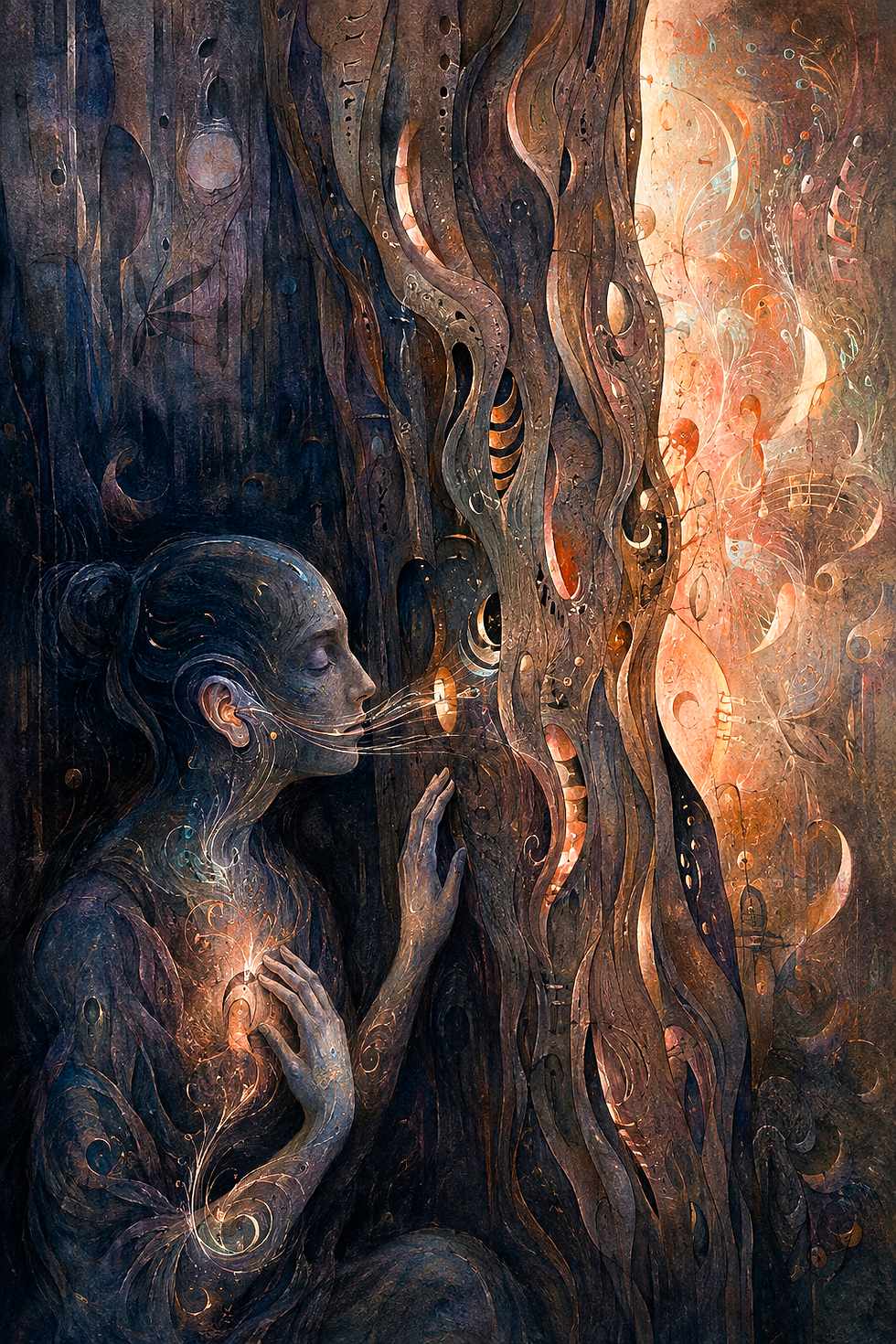
A solitary figure is enclosed by dense, dark forms, yet music slips through their boundaries and opens a luminous world beyond. Flowing contours and migrating symbols transform isolation into connection, suggesting that joy may arrive as a language heard before it is understood.

Reality and illusion occupy the same intricate world, their boundaries dissolving through nested landscapes, watchful eyes, and branching forms. The luminous white rabbit becomes an uncertain guide—perhaps delusion, perhaps insight - leading the solitary figure through a reality no longer governed by consensus.

The body becomes a petrified woodland, its joints, trunks, and mineral hollows bearing the weight of restricted movement. Yet vivid birds make their homes within it, their songs restoring leaves and nests—resilience not as cure, but as life finding new ways to move.

A solitary figure writes fading words on a world whose paths, landmarks, and meanings continually dissolve and reform. Faded ink, ghostly architecture, and migrating birdlike shapes evoke dementia as an uncertain passage through memory, where fragments of beauty persist even as recognition recedes.
Fairy Tale Essences
The following images evoke the essence of imaginary fairy tales rather than illustrating complete stories. Their worlds remain open, suggestive, and only partly explained. The language of metamorphosis is especially suited to such tales, allowing figures, landscapes, and symbols to transform as freely as wonder, danger, and meaning within the imagination.

The goat carries the stolen sun within him, while the boy’s embrace transforms catastrophe into tenderness—loving him not despite the darkness, but through the strange light he has become.

The sun reaches endlessly toward darkness, but its touch is also what drives the beloved away—leaving only crescents, doorways, and cool hollows as evidence that darkness was there a moment before.

A candle-eyed goat guides lost travelers through a forest where roots, roads, and centuries intertwine. Glimpses of distant cities promise home, but never the home remembered. Luminous details and flowing forms transform rescue into displacement: every return is also an arrival elsewhere.

The boy carries dusk as though it were both treasure and responsibility—sunset flowing from his hands into clothing, road, and village, turning the journey home into a final extension of the light.

Seven goats ascend toward the Orchard of the Moon, where celestial fruit holds the unimaginable abundance. Each bite of fruit changes the past and future of the world below, however. Luminous color, elongated forms, and dreamlike distortions give the scene the character of an illuminated folktale, while the changing worlds below reveal the devastating consequences of unchecked appetite.

The traveler’s reading awakens the glade from within: lantern light flows through the open book into roots and branches, while trees discover castles, dragons, instruments, and dreaming figures hidden in their own anatomy. The forest does not merely illustrate the story—it becomes absorbed in reading it, too.
Closing Remarks
The images in this exhibition were generated over just two days - August 9th and 10th, 2026. Yet the visual language that shaped them emerged far more slowly. Their prompts carry ideas, techniques, and preoccupations developed across months and, in some cases, years of experimentation with AI-generated art.
This is one of the medium’s central paradoxes: an image may appear within moments, while the creative process behind it unfolds gradually. Prompts evolve, styles gather definition, and themes disappear only to return in altered forms. Each new image grows from earlier discoveries, revisions, failures, and unexpected possibilities.
In this sense, the making of the exhibition mirrors Metamorphosis itself. Nothing begins fully formed, and nothing remains entirely fixed. The prompts are continually becoming - absorbing new influences and changing direction - while certain shapes, questions, and themes persist as recurring echoes. The images may be made quickly, but the language that makes them possible is still transforming.


Comments